In a nutshell: Quran letters contain the small letters and symbols in the Quran, known as Rumuz al-Awqaf (stopping signs), guide readers on where to pause, stop, or continue reciting. Rooted in the science of Tajweed, these markings preserve the Quran’s true meaning and ensure its recitation reflects how it was revealed to Prophet Muhammad (peace be upon him).
You’ve opened the Mus’haf, your heart is ready to connect with Allah’s words, and then you see them: a tiny ‘م’ (meem), a ‘لا’ (laa), or a ‘قلى’ (qali) perched above the Arabic text.
What are these? Are you supposed to stop? Keep going?
It’s a question every sincere student of the Quran asks. Let me assure you, these aren’t obstacles. They are guides.
Quran letters.. Why Do These Small Letters in the Quran Matter?
These small letters in the Quran are known as Rumuz al-Awqaf (Stopping Signs) to protect you—the Quran reader—from stopping or pausing in a way that could accidentally corrupt or change the intended meaning.
These small letters in the Quran are part of Tajweed, the science of reciting the Quran exactly as it was revealed to the Prophet Muhammad (peace and blessings be upon him).
They were meticulously placed in the Uthmani script by generations of scholars.
Stopping at the wrong place can, in some cases, change the meaning from a statement of faith to one of disbelief.
Pausing incorrectly can sever a connection between a question and its answer. These symbols are your map, ensuring you navigate the divine text safely and preserve its intended message.
This is precisely where the science of Tajweed moves from theory to practice. It’s the foundation we build in our Learn Quran with Tajweed courses, ensuring you don’t just see the symbols, but truly understand their purpose in preserving the divine message.
Enroll Now in Our Tajweed Course
Read Also: What Does م Mean In The Quran?
1. The Small Meem (م) for The Mandatory Stop (Quran Letters)
This symbol is the small ‘م’ (meem), and it stands for al-Waqf al-Lazim (a necessary stop). You must stop here. It is not optional.
Continuing to read would merge two separate ideas and create a confusing or incorrect meaning.
For example, in Surah Al-An’am, Allah says:
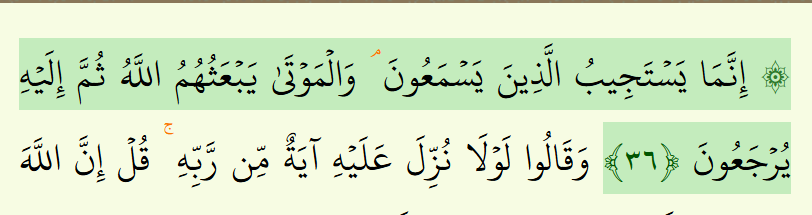
(Innama yastajeebul-ladheena yasma’oon. Walmawta yab’athuhumullah)
“Only those who hear will respond. But the dead – Allah will resurrect them.”
The mandatory stop (represented here by the مـ symbol, which is often the ‘م’ in many prints) after yasma’oon (they hear) is critical.
It separates the living who can respond from the dead, whose case is with Allah. Connecting them would muddle the entire message.
Read Also: What does لا Mean in the Quran? – Prohibited Stop In the Quran
2. The Small ‘La’ (لا) for The Prohibited Stop (Quran Letters)
This is ‘لا’ (laa), which means “No.” It signals al-Waqf al-Mamnu’ (a prohibited stop). Do not stop here. You must continue reading until the next natural break.
Stopping here would cut the meaning short, often in a way that makes no sense or, worse, implies something completely untrue.
Allah describes the righteous at the moment of their death:
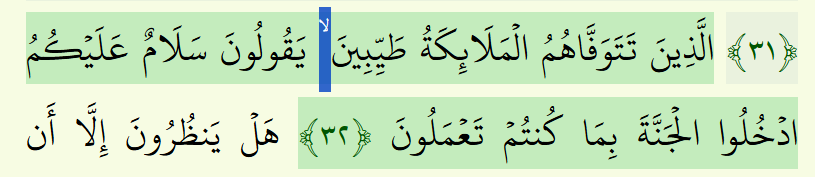
(Alladheena tatawaffahumu-l-malaa’ikatu tayyibeena yaqooloona salaamun ‘alaykumu…)
“Those whom the angels take in death while they are good and pure, [the angels] saying, ‘Peace be upon you…'” (An-Nahl, 16:32)
The ‘لا’ is placed after the word tayyibeen (good and pure).
If you were to stop here, you would end the sentence, separating the state of the believers (being “pure”) from the immediate action of the angels.
The ‘لا’ prohibits this stop, forcing you to connect them. It makes the recitation flow as one single, beautiful event: the angels are taking their souls while simultaneously greeting them with peace. The ‘لا’ sign protects this crucial, unbroken connection.
If you accidentally run out of breath and stop at a ‘لا’, you must go back to a word before it and continue your recitation correctly.
Read Also: What Does ط Symbol Mean In The Quran?
3. The Small ‘Qali’ (قلى) for The Preferred Stop (Quran Letters)
This is ‘قلى’ (qali), which is an abbreviation for al-Waqf Awla (stopping is better). Stopping is preferred. While you can continue, the sentence is more complete and the meaning is clearer if you pause here.
This symbol often appears at the end of a complete thought. Stopping here allows you to take a breath and let the meaning sink in before starting the next related concept. It signals a strong, clear pause.
In Surah Al-Ma’idah, Allah explains a ruling regarding testimony:
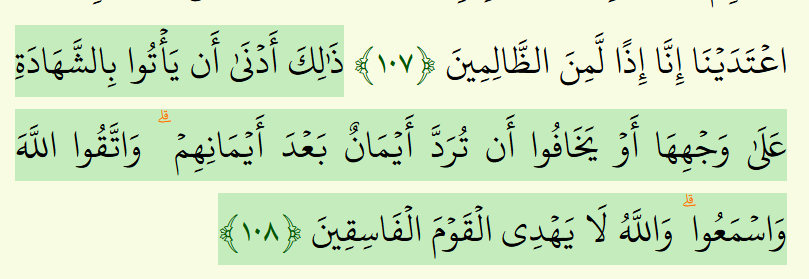
” (Dhalika adna an ya’too bish-shahadati ‘ala wajhiha aw yakhafoo an turadda aymanun ba’da aymanihim. Wat-taqullaha wasma’oo…)
“That is more likely that they will give testimony according to its [true] face, or they will fear that [other] oaths will be taken after their oaths. And fear Allah and listen…” (Al-Ma’idah, 5:108)
The ‘قلى’ symbol (shown as ۗ in this print) comes after ba’da aymanihim (“after their oaths”). This completes the entire explanation of the ruling and its wisdom.
The verse then continues with a new, distinct set of commands: “And fear Allah and listen…”
The ‘قلى’ signals that stopping to absorb the first complete thought is the better, more impactful way to recite before moving on to the subsequent commands.
4. The ‘Sali’ (صلى) for The Preferred Connection (Quran Letters)
This is ‘صلى’ (sali), an abbreviation for al-Wasl Awla (connecting is better). It means that continuing is preferred.
While stopping here is permissible (it’s not forbidden like ‘لا’), the flow of the meaning is stronger and more connected if you continue. It tells you that the ideas on both sides of the sign are very closely linked.
For example, in Surah Al-Baqarah (2:38):
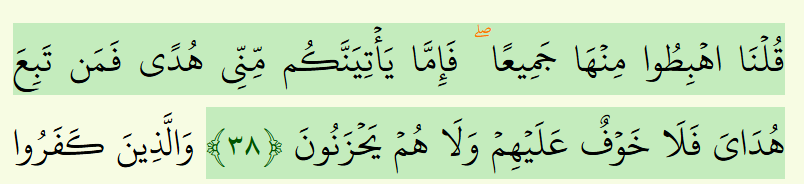
(Qulnah-bitoo minha jamee’an fa’imma ya’tiyannakum minnee hudan…)
“We said, ‘Go down from it, all of you.’ And when guidance comes to you from Me…”
Notice at the end of the word “جَمِيعًا” (jamee’an), there is a symbol. This means that continuing is preferred.
The ‘صلى’ symbol gives you advice on that permissible stop, but also tells you that while you can stop, it is better to connect.
Connecting the two parts—”Go down, all of you” and “And when guidance comes to you”—links Allah’s divine command directly to His immediate promise of mercy and guidance. It makes the recitation flow as one single, uninterrupted decree.
5. The ‘Jeem’ (ج) for The Permissible Stop (Quran Letters)
This is the small ‘ج’ (jeem), which stands for Waqf Ja’iz (a permissible stop).
This is the “neutral” sign. It means you have a choice. Stopping is allowed, and continuing is also allowed.
Both options are perfectly acceptable, and the meaning is sound either way. The ‘ج’ simply marks a point where it is perfectly fine to take a breath if you need one, without any preference for stopping or continuing.
An example is in Surah Al-Baqarah (2:44) shows this clearly:
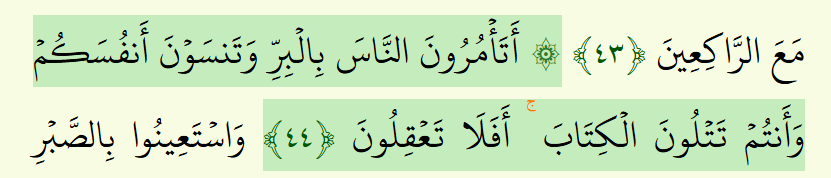
(Ata’muroonan-nasa bil-birri wa tansawna anfusakum wa antum tatloona-l-kitaba afala ta’qiloon)
“Do you order righteousness of the people and forget yourselves, while you recite the Scripture? Then will you not reason?”
The ‘ج’ symbol is placed right after the word “الْكِتَابَ” (al-Kitab / the Scripture).
You can stop: “…while you recite the Scripture.” (Pause). “Then will you not reason?” This stop creates a powerful rhetorical effect, allowing the listener to absorb the irony of the first statement before the question is posed.
You can continue: “…while you recite the Scripture, then will you not reason?” This connects their action (reciting the book) immediately to their failure (not reasoning), making it one flowing, sharp rebuke.
Both ways are perfectly correct. The ‘ج’ gives you that choice.
6. The “Coordinated Stops” (The Three Dots ∴ ∴) (Small Letters in The Quran)
Sometimes you’ll see a set of three dots (∴) in two different places, usually close to each other. These are the Mu’anaqah (Embracing Stops). You must stop at one of them, but not both. Think of it as an “either/or” rule.
A famous example is at the very beginning of Surah Al-Baqarah:
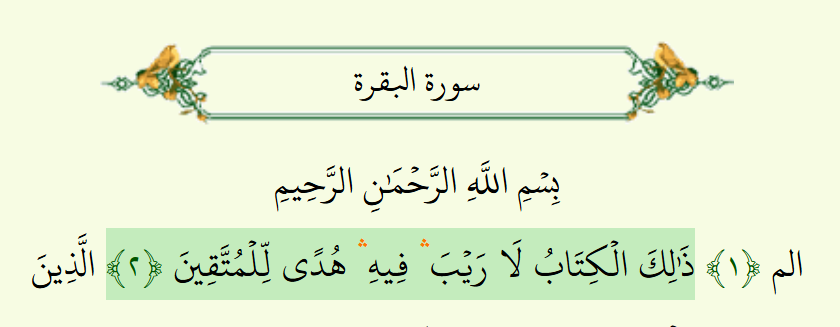
(Dhalika-l-Kitabu la rayba feehi hudal-lilmuttaqeen)
“This is the Book about which there is no doubt, a guidance for those conscious of Allah.”
The dots are after rayba (doubt) and fih (in it).
You can stop at rayba: “This is the Book, there is no doubt. ∴ In it is guidance for the pious.”
You can stop at fih: “This is the Book, in which there is no doubt. ∴ A guidance for the pious.”
Both readings are correct and beautiful. But stopping at both (“This is the Book, no doubt… in it…”) would create a choppy, incomplete meaning. These dots graciously preserve both valid interpretations for the reader.
7. The Small ‘Seen’ (س) in Mushaf (Small letters in the Quran)
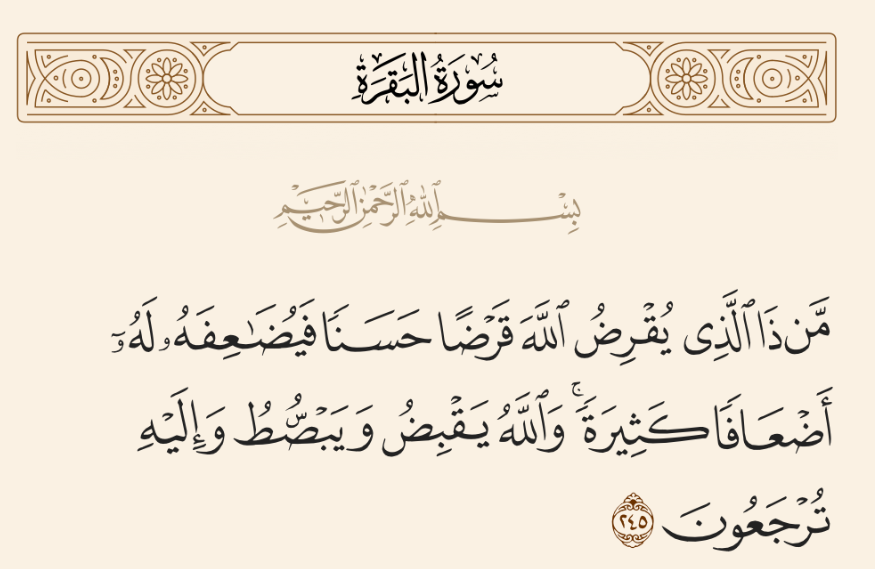
Finally, you may see another symbol that isn’t a pause mark, but a guide for pronunciation. This is the tiny ‘س’ (seen) written above the letter ‘ص’ (saad).
It signals that in this specific word, you should pronounce the heavy letter ‘ص’ (saad) with a light ‘س’ (seen) sound.
This is a very precise rule of Tajweed for the narration of Hafs ‘an ‘Asim (the one most non-Arabs use).
For example, in Surah Al-Baqarah, the word “وَيَبْصُۜطُ” (wa yabsutu) “and extends” (2:245), the ‘س’ above the ‘ص’ tells you to pronounce it “yab-su-tu,” not with the heavy “yab-soo-tu.”
This is a subtlety that is almost impossible to master from a book and truly requires a qualified teacher to demonstrate and correct.
Read Also: What Does the Small Jeem Mean in Quran?
🔗 You can explore these small Quran letters directly on the Quran text using platforms like Quran.com.
Start Your Path From ‘Reading’ to ‘Reciting’ with Quranica
At Quranica, we bridge that gap. We believe authentic learning requires authentic teachers. That is why our instructors are:
Native Arab Speakers & Al-Azhar Graduates
They possess a deep, innate understanding of the Quran’s language and context.
Ijazah-Certified
Every Quran tutor holds an Ijazah (certification) to teach the Quran, passing its knowledge down in an unbroken chain.
Experienced with Non-Arabs
They specialize in guiding learners just like you, understanding the exact challenges you face.
Whether you want to…
- Finally master the flow of Quran Recitation with Tajweed,
- Understand the deep meanings with our Online Tafseer Course,
- Connect with the original text through Quranic Arabic,
- Or build a family legacy with our Quran Memorization (Hifz) Programs (for kids, ladies, and adults!),
…we are here to hold your hand.
Explore our full range of courses.
Conclusion
In quran letters, Each small letter in the Quran carries deep purpose—protecting the divine message from misinterpretation and helping readers recite with both accuracy and reverence. These marks transform recitation from mechanical reading into a mindful act of worship.
Understanding when to stop, continue, or connect verses ensures that the intended meaning flows naturally, preserving the spiritual and linguistic beauty of Allah’s words. They’re not just rules—they’re a map that guides your tongue and heart together.
Mastering these signs through proper Tajweed training allows every reciter to honor the Quran as it was revealed. With the guidance of a qualified teacher, what once seemed like tiny marks become keys to unlocking the depth, clarity, and harmony of the Quranic message.
0 Comments