
If you truly want to transform your life, sharpen your heart, and unlock the deepest spiritual clarity, then you cannot afford to ignore the life-changing benefits of reading the Quran at Night, in the early Morning, and during Fajr. These three blessed times are not “recommended moments” — they are divine opportunities that multiply your reward, cleanse your heart, and elevate your connection with Allah in ways daytime reading simply cannot match.
Reading the Quran at Night floods your chest with tranquility when the world is silent. Reading it in the Morning sets the direction of your entire day with light and discipline. And reading it at Fajr opens the gates of guidance at the exact moment the angels witness your recitation. These aren’t small benefits — they are massive spiritual upgrades that every Muslim needs, especially in a fast, noisy world where hearts are exhausted and faith is constantly tested.
If you’ve been struggling with consistency, emotional clarity, inner peace, or even understanding your purpose, then mastering these three times will rebuild your spiritual strength from the ground up. This article reveals exactly why these moments are so powerful — and how you can start benefiting from them today, no matter your schedule or level.
Reading the Quran at Fajr, morning, and night carries distinct spiritual and psychological benefits shaped by the unique energy of each time. Dawn strengthens memorization and sets the tone for the day, the morning offers clarity and protection from distraction, and the night opens the deepest doors to reflection, sincerity, and healing.
The energy of the world changes from the silence of 4:00 AM to the bustle of 8:00 AM to the stillness of midnight.
We are not machines. We cannot expect to have the same focus or spiritual connection at every hour.
Understanding the specific qualities of these times helps you stop fighting your own clock and start working with it. Let’s look at how shifting your reading time changes your relationship with the Book of Allah.
1. The Profound Benefits of Reading Quran at Fajr For Memorization
If you ask any Quran teacher for the golden rule of memorization (Hifz), they will point you to the time before sunrise.
There is a spiritual reason for this, and there is a biological one.
Spiritually, this time is special because it is attended by the angels of the night and the angels of the day. Allah says in Surah Al-Isra:
“أَقِمِ الصَّلَاةَ لِدُلُوكِ الشَّمْسِ إِلَىٰ غَسَقِ اللَّيْلِ وَقُرْآنَ الْفَجْرِ ۖ إِنَّ قُرْآنَ الْفَجْرِ كَانَ مَشْهُودًا”
“Aqimi assalata liduluki ashshamsi ila gha saqi allayli waqur-ana alfajri inna qur-ana alfajri kana mashhuda”
“Establish prayer at the decline of the sun [from its meridian] until the darkness of the night and [also] the Qur’an of dawn. Indeed, the recitation of dawn is ever witnessed.” (Al-Isra 17:78)
“Mashhuda” means witnessed. The angels of the night and the angels of the day meet at this specific time to listen to your recitation.
While the verse indicates that angels bear witness to the recitation during the Fajr prayer, it ultimately highlights the profound sanctity of the dawn time as a whole.
Biologically, this is the most critical time for our non-Arab students. When you wake up for Fajr, your brain is a blank slate. You haven’t checked your emails yet. You haven’t spoken English or your native language yet. Your “linguistic cache” is empty.
This implies that the barrier to entry is lower. However, the hardest part of Fajr is simply showing up. This is where having a dedicated teacher makes all the difference.
If you join our Quran Memorization and Hifz program, you are not just getting a tutor; you are getting an accountability partner waiting for you. It changes the dynamic from ‘I should wake up’ to ‘someone is waiting for me,’ which is often the push you need to succeed.
Enroll Now in Quranica’s Memorization and Hifz programs

2. Untying The Spiritual Knots is One of The Benefits of Reading Quran at Fajr
There is a heaviness we all feel when the alarm goes off. It is not just physical tiredness; it is a spiritual weight.
The Prophet (peace be upon him) explained that when we sleep, Satan ties three knots at the back of our heads to keep us in a state of slumber and laziness.
The only way to undo these knots is through a specific sequence: waking up, making Wudu, and praying. Reading the Quran at this specific time is the final seal of victory over that lethargy.
We tell our students that the recitation at Fajr is the “untying” of the soul. If you skip it, you might notice a sluggishness that follows you all day, no matter how much coffee you drink.
But when you push through the desire to sleep and recite those first few verses, you are literally breaking the chains that hold you down.
You enter your day feeling light, active, and victorious. This psychological win—knowing you conquered your own nafs before the sun even came up—gives you a confidence that lasts until sunset.
Read Also: Benefits and Rewards of Reading Quran Daily
3. Setting The Daily Record is One of The Benefits of Reading Quran at Fajr
Every new day is a new page in your book of deeds. The angels who record your actions start a fresh entry at Fajr.
We always ask our students: What do you want the very first line of today’s page to be? Do you want it to be scrolling through social media? Do you want it to be complaining about the cold weather? Or do you want the opening line of your day to be the words of Allah?
Reading Quran at Fajr sets the standard for the rest of the record. It is a declaration of priority. By ensuring the first words that leave your mouth are Quranic verses, you are sanctifying the entire day.
Reading Quran at Fajr acts as a filter. When you start with something so pure, you often find yourself hesitant to use that same tongue for lying or backbiting later in the afternoon. You naturally want to protect the purity you established at dawn.
We recommend preparing your heart and mind through supplication (Dua) before reciting the Quran. It is also encouraged to make Dua after you reading Quran.
4. Capturing Barakah is One of The Benefits of Reading Quran in The Morning
Once the sun has risen and the day officially begins, the nature of the benefit shifts. We move from the deep, quiet memorization of Fajr to the need for fuel and protection for the day ahead.
The Prophet Muhammad (peace be upon him) made a specific supplication for this time: “O Allah, bless my Ummah in their early hours.” This blessing, or Barakah, is real.
We all know the anxiety of a busy workday. The to-do list is long, and the stress starts the moment you look at your phone.
The primary benefit of reading Quran in the morning—specifically between sunrise and the start of work—is psychological armor.
When you give the first 15 or 30 minutes of your active morning to the Quran, you are setting a “divine pacing” for the rest of the day. You are telling your heart that despite the rush, Allah comes first.
I have seen a distinct difference in professionals who read in the morning. They handle workplace stress with more composure.
The Barakah manifests as time expansion; they get more done in less time because their mind is not cluttered with anxiety. The morning recitation clears the mental fog before the storm of the day hits.
But perhaps you feel that your reading is too slow to fit into a busy morning. You might think, ‘It takes me ten minutes just to read one line.’ Do not let that stop you. Our Learn Quran Reading course is designed specifically to move you from stuttering to fluency. We help you build the speed and confidence you need so that your morning reading feels like a refreshing breeze, not a heavy task.
Enroll Now in Quranica’s Learn Quran Reading Course
Read Also: What Are the Manners and Etiquette of Reading The Quran?
5. Escaping Heedlessness is Among The Benefits of Reading Quran in The Morning
There is a concept called Ghaflah, which means heedlessness or forgetfulness. The time between sunrise and noon is when the world is at its loudest.
The markets are open, emails are flying, and everyone is obsessed with earning a living. This is the peak time for Ghaflah.
Reading the Quran in the morning, specifically during the forenoon (Duha) hours, is a powerful act of rebellion against this forgetfulness. While the rest of the world is rushing after created things, you are pausing to connect with the Creator.
There is a massive reward for remembering Allah when others are distracted. It anchors you. We have observed that who take a “Quran break” around 10:00 AM or 11:00 AM often have better emotional regulation.
They don’t get swept up in the office drama or the panic of deadlines. By inserting the words of Allah into the busiest part of the day, you remind yourself that the worldly chaos is temporary, and the words you are reading are eternal.
Read Also: Scientific and Spiritual Benefits of Reading Quran
6. The Benefits of Reading Quran at Night For Reflection
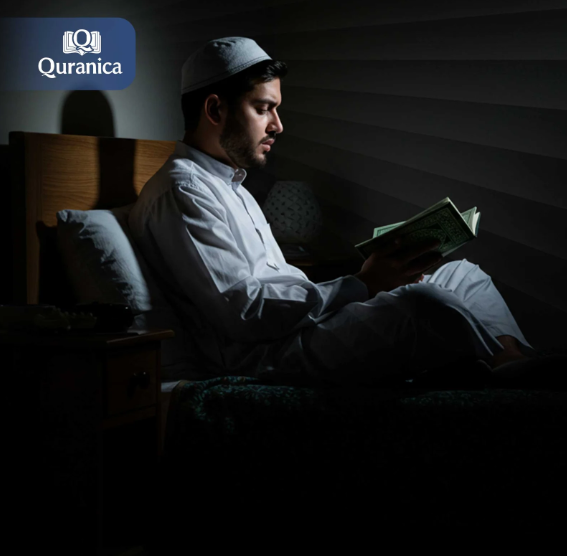
The morning is for energy and the dawn is for memorization, the night is for the heart. The Quran calls this Nashiat al-Layl—the rising by night.
It is harder to stand up at night or stay awake after Isha when your body is tired. But because it is harder, the impression it leaves on the soul is stronger. Allah describes this in Surah Al-Muzzammil:
“إِنَّ نَاشِئَةَ اللَّيْلِ هِيَ أَشَدُّ وَطْئًا وَأَقْوَمُ قِيلًا”
“Inna nashi-ata allayli hiya ashaddu wat-an wa-aqwamu qila”
“Indeed, the hours of the night are more effective for concurrence [of heart and tongue] and more suitable for words.” (Al-Muzzammil 73:6)
The phrase “Ashaddu wat-an” implies a deeper footprint. When you read at night, the words sink in.
The distractions of the world have faded. The kids are asleep. The phone has stopped buzzing. It is just you and your Lord.
For our students who struggle to connect emotionally with the Quran, we always prescribe night reading. This is the time for Tadabbur (deep reflection) and Tartil (slow, measured recitation).
The silence of the night allows you to hear your own voice and, more importantly, to hear the message of the verses without the interference of daily noise.
If you are looking to correct your pronunciation, the night is excellent because you are not rushing to go anywhere. You can repeat a verse ten times, tasting the letters, correcting your Tajweed, and letting the meaning settle in your chest.
Yet, practicing alone at night can sometimes reinforce mistakes if you aren’t sure of the rules. The night is for reflection, but it requires a correct foundation.
This is the ideal time to apply what you learn in our Learn Quran with Tajweed classes. When you study the rules with an expert during the day and practice them in the quiet of the night, your recitation transforms from a struggle into a beautiful, melodic act of worship
Enroll Now in Quranica’s Tajweed Course

Read Aslo: What Are the Manners and Etiquette of Reading The Quran?
7. Cultivating Sincerity is One of The Benefits of Reading Quran at Night
The day is for the public. We often do good deeds during the day where people can see us. We pray in congregation; we give charity openly. But the night? The night is for secrets.
One of the greatest dangers for a student of the Quran is Riya—doing things to be seen or praised by others. The night protects you from this.
When you stand up to read at 2:00 AM, no one is clapping for you. No one is admiring your beautiful Maqamat or your perfect Tajweed. It is just you and your Lord.
This seclusion builds Ikhlas (sincerity) in a way that daytime reading cannot. It strips away the ego.
When we teach advanced students who are struggling with arrogance or pride in their recitation, we prescribe the “Night Cure.” we tell them to hide their worship.
“تَتَجَافَىٰ جُنُوبُهُمْ عَنِ الْمَضَاجِعِ يَدْعُونَ رَبَّهُمْ خَوْفًا وَطَمَعًا”
“Tatajafa junubuhum ‘ani al-madaji’i yad’una rabbahum khawfan wa tama’an”
“Their sides part [i.e., they arise] from [their] beds; they supplicate their Lord in fear and aspiration.” (As-Sajda 32:16)
This verse speaks to the physical struggle of leaving a warm bed. The benefit here is not just in the amount you read, but in the honesty of the act.
A single page read in the secrecy of the night, purely for Allah, can weigh heavier on the scale than an entire Juz read in public.
Read Also: Where to Stop While Reading The Quran? – Rules of Waqf and Ibtida
8. The Direct Response is One of The Benefits of Reading Quran at Night
If you have a specific need—a job you want, a sickness you need cured, a family issue—the night is the time to ask for it. There is a special window in the last third of the night that does not exist at any other time.
The Prophet (peace be upon him) told us that our Lord descends to the lowest heaven during the last third of the night and asks:
“مَنْ يَدْعُونِي فَأَسْتَجِيبَ لَهُ مَنْ يَسْأَلُنِي فَأُعْطِيَهُ مَنْ يَسْتَغْفِرُنِي فَأَغْفِرَ لَهُ”
“Who is calling upon Me that I may answer him? Who is asking of Me that I may give him? Who is seeking forgiveness of Me that I may forgive him?” (Sahih al-Bukhari)
Combining recitation with Dua at this time is like having a private audience with your Lord while everyone else is asleep.
When you read the Quran at night, you are already in a state of worship. If you pause after a verse of mercy to ask for that mercy, or pause after a verse of forgiveness to ask to be forgiven, you are aligning your request with the most potent time for acceptance. So, I think you have to think about how to start reading Quran daily.
9. Emotional Healing is One of The Deep Benefits of Reading Quran at Night
We accumulate emotional “micro-traumas” throughout the day. A rude comment from a boss, a sad news story, a moment of jealousy—these things stick to us like dust. If you go to sleep with this dust on your heart, you wake up heavy.
Reading the Quran at night acts as a spiritual shower for these emotions. It is an emotional detox.
When you read verses about the mercy of Allah or the temporary nature of this world right before bed, you are recalibrating your perspective.
You are reminding yourself that the problem that stressed you out at 2:00 PM is insignificant in the grand scheme of the Afterlife.
We teach our students to use the night recitation not just for reward, but for therapy. It allows you to close the “tabs” in your brain.
You hand your worries over to Allah through His words, allowing you to sleep with a clean heart and a peaceful mind. It is the ultimate antidote to insomnia caused by overthinking.
Start Your Quranic Journey with Quranica – the Right Companion
At Quranica, we bridge the gap between your desire to learn and the mastery of the Quran.
We don’t just offer classes; we offer a connection to the source.
Our teachers are Native Arabs and Al-Azhar University graduates, meaning you are learning from the most prestigious lineage of Islamic knowledge.
All our instructors hold Ijazah and have years of specialized experience helping non-Arabic speakers overcome language barriers.
We believe quality Quranic education should be within reach, offering competitive pricing without compromising on excellence.
Whether you want to wake up for Hifz, fix your reading for your morning routine, or perfect your Tajweed for the night, we have a structured path for you.
Explore our tailored courses:
- Learn Quran Reading: For beginners ready to connect with the script.
- Quran Memorization and Hifz: structured plans for kids and adults.
- Learn Quran with Tajweed: To beautify your recitation.
- Online Ijazah Course: For advanced learners seeking mastery.
- Islamic Studies: Building a strong foundation.
- Learn Arabic Online Course: To understand the language of the Revelation.
Explore our full range of courses.
Book your free evaluation class and start your first real lesson today.

Conclusion
The early hours of Fajr offer unmatched support for memorization, mental clarity, and spiritual awakening.
Reciting at dawn breaks inner heaviness, sets the day’s first recorded deed, and anchors the heart before the world becomes noisy.
Morning recitation after sunrise strengthens focus, expands Barakah in daily tasks, and guards the heart from heedlessness during busy hours.
Night recitation invites deep reflection, sincerity, and emotional healing in a way daytime reading cannot. In the stillness of darkness, the words settle more powerfully, intentions become purer, and personal prayers find a special window for acceptance.






0 Comments