What Does the Quran Say About Female Education?
In a nutshell: The Quran commands the pursuit of knowledge as a universal duty for all believers—men and women alike. Its verses emphasize learning, reflection, and inquiry as divine obligations, elevating those who seek knowledge to higher ranks. From revelation to example, the Quran celebrates the educated believer, making no distinction of gender in the pursuit of ‘ilm (knowledge).
In almost every single instance, the call to seek, to reflect, to ponder, and to understand is addressed to humanity, to the believer, or to people – not to a specific gender.
This is the foundation from which our entire discussion must begin. The question is not “Does the Quran allow female education?” The real question is “How does the Quran command knowledge for all?”
1. The Quran’s Foundational View on Knowledge for All
The very first word revealed to our beloved Prophet Muhammad (peace and blessings be upon him) wasn’t “pray,” “fast,” or “fight.” It was a command that shattered the foundations of an illiterate, tribal society.
“اقْرَأْ بِاسْمِ رَبِّكَ الَّذِي خَلَقَ”
“Iqra bismi rabbika allathee khalaq”
“Read! In the Name of your Lord Who created.” (Surah Al-Alaq, 96:1)
The command is Iqra (Read!). In Arabic grammar, this imperative verb (fi’l amr) is a direct order. It is addressed to the Prophet, and by extension, to every single person who follows him until the end of time.
There is no gender marker here. It is a unifying command to every soul: move from a state of ignorance to a state of knowledge. This is the starting point of our entire faith.
This is why a simple reading is just the beginning. A journey into Tafseer (exegesis) helps you unlock why this verse is so profound.
Enroll Now in Our Online Tafseer Course
2. Quran’s View on the Rank of Female Education
The Quran doesn’t just command us to learn; it elevates those who possess knowledge to the highest of ranks. And once again, it does so using language that is gloriously gender-neutral.
“قُلْ هَلْ يَسْتَوِي الَّذِينَ يَعْلَمُونَ وَالَّذِينَ لَا يَعْلَمُونَ”
“Qul hal yastawee alladheena ya’lamoona walladheena la ya’lamoon”
“Say: ‘Are those who know equal to those who do not know?'” (Surah Az-Zumar, 39:9)
This is a powerful rhetorical question, and its answer is a resounding no. Look at the Arabic: alladheena ya’lamoon (those who know). This is a plural phrase referring to a group of people defined by a single, beautiful quality: their ilm (knowledge).
The Quran creates a fundamental distinction not between man and woman, but between the knowing and the unknowing. True status in the eyes of Allah is built on Taqwa (God-consciousness) and knowledge, both of which are open to all.
3. The Quran on Female Education as a Duty
So, Allah commands us to “Read” and tells us that “those who know” are of a higher rank. But how do we gain this knowledge? The Quran gives a clear, practical instruction.
“فَاسْأَلُوا أَهْلَ الذِّكْرِ إِن كُنتُمْ لَا تَعْلَمُونَ”
“Fas’aloo ahla adh-dhikri in kuntum la ta’lamoon”
“So ask the people of knowledge if you do not know.” (Surah An-Nahl, 16:43)
Look closely at the command: Fas’aloo (So, ask!). This is a plural command. It is a duty placed on every single believer.
If you are ignorant on a matter—whether spiritual or worldly—you are obligated to seek out ahla adh-dhikri (the people of remembrance/knowledge).
This active pursuit is the core of Islamic learning. The Quran envisions a dynamic, intelligent society where everyone, women included, is actively seeking answers, questioning, and learning.
This is powerfully reinforced by the Prophet (peace be upon him) who stated clearly:
“Seeking knowledge is an obligation upon every Muslim.” (Sunan Ibn Majah).
The word “Muslim” here is all-inclusive.
This is the spirit behind our Islamic Studies Online Courses—to provide a structured, authentic space for you to fulfill this beautiful obligation to “ask” and to “know.”
Enroll Now in Quranica’s Islamic Studies Courses for ladies
4. When a Woman’s Inquiry Became Part of the Quran
If any doubt remained about a woman’s place in intellectual and spiritual discourse, the Quran itself gives us one of the most powerful, direct examples.
“قَدْ سَمِعَ اللَّهُ قَوْلَ الَّتِي تُجَادِلُكَ فِي زَوْجِهَا وَتَشْتَكِي إِلَى اللَّهِ”
“Qad sami’a Allahu qawla allatee tujadiluka fee zawjiha wa tashtakee ila Allah”
“Allah has indeed heard the speech of the one who argues with you concerning her husband and complains to Allah.” (Surah Al-Mujadila, 58:1)
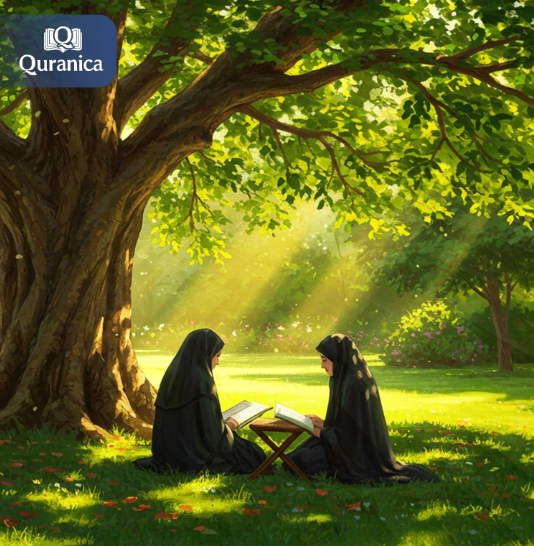
This is one of the profound events in the Seerah (Prophetic biography). A woman, Khawlah bint Tha’labah, came to the Prophet (pbuh) not in silence, but to argue a point of law. The Arabic word used is tujadiluka—she disputes or argues with you.
She was not passive. She was educated, articulate, and sought justice and knowledge directly from the Prophet. And how did Allah respond?
Allah did not rebuke her for “speaking out.” He heard her (sami’a Allahu), validated her, and revealed a new divine law based on her specific complaint.
An entire chapter of the Quran is named “She Who Argues” (Al-Mujadila). This is the Quranic model: an educated, empowered woman whose voice was immortalized as divine revelation.
Read Also: What We Learn From Quran? – Top Lessons
5. How the Quran Elevates Those With Knowledge Including Females
We spoke earlier about how the “knowing” and “unknowing” are not equal. But Allah, in His grace, goes even further. He doesn’t just state they are different; He promises a specific, tangible reward for those who pair their faith with knowledge.
“يَرْفَعِ اللَّهُ الَّذِينَ آمَنُوا مِنكُمْ وَالَّذِينَ أُوتُوا الْعِلْمَ دَرَجَاتٍ”
“Yarfa’i Allahu alladheena amanoo minkum walladheena ootoo al-‘ilma darajat”
“Allah will raise those who have believed among you and those who were given knowledge, by degrees (in rank).” (Surah Al-Mujadila, 58:11)
Subhan’Allah. Look at the beauty of this. The verb is Yarfa’i (He will raise). This is a divine promise. Allah Himself will elevate you.
But who? He specifies two groups: alladheena amanoo (those who have believed) and alladheena ootoo al-‘ilm (those who were given knowledge). Faith and knowledge are the two wings that allow a believer to ascend.
The rank is not open only to men. The phrase alladheena ootoo al-‘ilm is universal. A woman who dedicates her life to seeking and mastering the Quranic sciences is explicitly included in this promise of elevation.
Read Also: What the Quran Says About Family?
6. Quran Commands Males and Females to Always Seek More Knowledge
If there is one verse that should be the motto of every student, every teacher, and every believer, it is this one. It is a direct command from Allah to the Prophet Muhammad (peace and blessings be upon him) himself.
“وَقُل رَّبِّ زِدْنِي عِلْمًا”
“Wa qul rabbi zidnee ‘ilman”
“And say: ‘My Lord, increase me in knowledge.'” (Surah Taha, 20:114)
This, for me, is one of the most humbling verses in the entire Quran. Allah commands His final Messenger—the most knowledgeable of all creation—to ask for more.
The command is Qul (Say!). It is an imperative, just like Iqra (Read!). We are commanded to make this supplication. And what do we ask for? Not for wealth, not for power, not for long life, but for one thing: zidnee ‘ilman (increase me in knowledge).
This verse establishes that knowledge is not a destination you arrive at. It is a lifelong, sacred journey. There is no “I have learned enough.”
Read Also: What Does the Quran Say About Hijab?
Begin Your Journey to ‘Ilm Now With Quranica
Many of our instructors – including female instructors – are not just native Arabic speakers; they are passionate graduates of Al-Azhar University, the world’s most ancient seat of Islamic learning.
Our teachers are Ijazah-holders, possessing an unbroken, certified chain of transmission to teach the Holy Quran.
They have years of dedicated experience guiding non-Arab students just like you. They understand your unique challenges and your passion for learning.
We are committed to making this journey possible for everyone, offering competitive and affordable pricing for world-class, one-on-one instruction.
Find your perfect path with our specialized courses:
The Foundation
Start with the keys to the language in our Arabic lessons for beginners or focus specifically on the Holy Book’s vocabulary with our Quranic-Arabic program.
The Recitation
We offer dedicated Online Tajweed Classes for Sisters for a comfortable and focused environment.
The Depth
Go deeper into the ocean of meaning with our Online Quran Tafseer Course or our comprehensive Islamic Studies Courses for ladies.
The Ultimate Goal
Fulfill the dream of carrying the Quran in your heart with our structured Quran Memorization and Hifz Programs, including specialized Hifz classes for Ladies and Sisters.
Explore our full range of courses.
For additional learning opportunities and community programs, you can also explore respected Islamic centers such as In the UK:
• Islamic Centre of England – London
• Islamic Dawah Centre (IDC)
In the United States:
• Islamic Center of America – Dearborn, Michigan
• Islamic Center of Southern California – Los Angeles
• Islamic Cultural Center of New York
Conclusion
The Quran’s message on learning is clear and timeless—knowledge is not a privilege but a command from Allah for every believer. The first word revealed, “Iqra” (Read!), laid the foundation for an educated and reflective society rooted in divine understanding.
Throughout its verses, the Quran honors those who seek knowledge, showing no gender bias but rather linking true honor and spiritual elevation to faith and learning.
The story of Khawlah bint Tha‘labah stands as a living testimony to the Quran’s respect for women’s intellect and voice.
The journey of seeking knowledge is lifelong. Allah Himself commands believers to pray, “My Lord, increase me in knowledge.”
This sacred pursuit is open to all who wish to grow in wisdom, faith, and understanding—an invitation to rise through the ranks of knowledge and nearness to Allah.
0 Comments