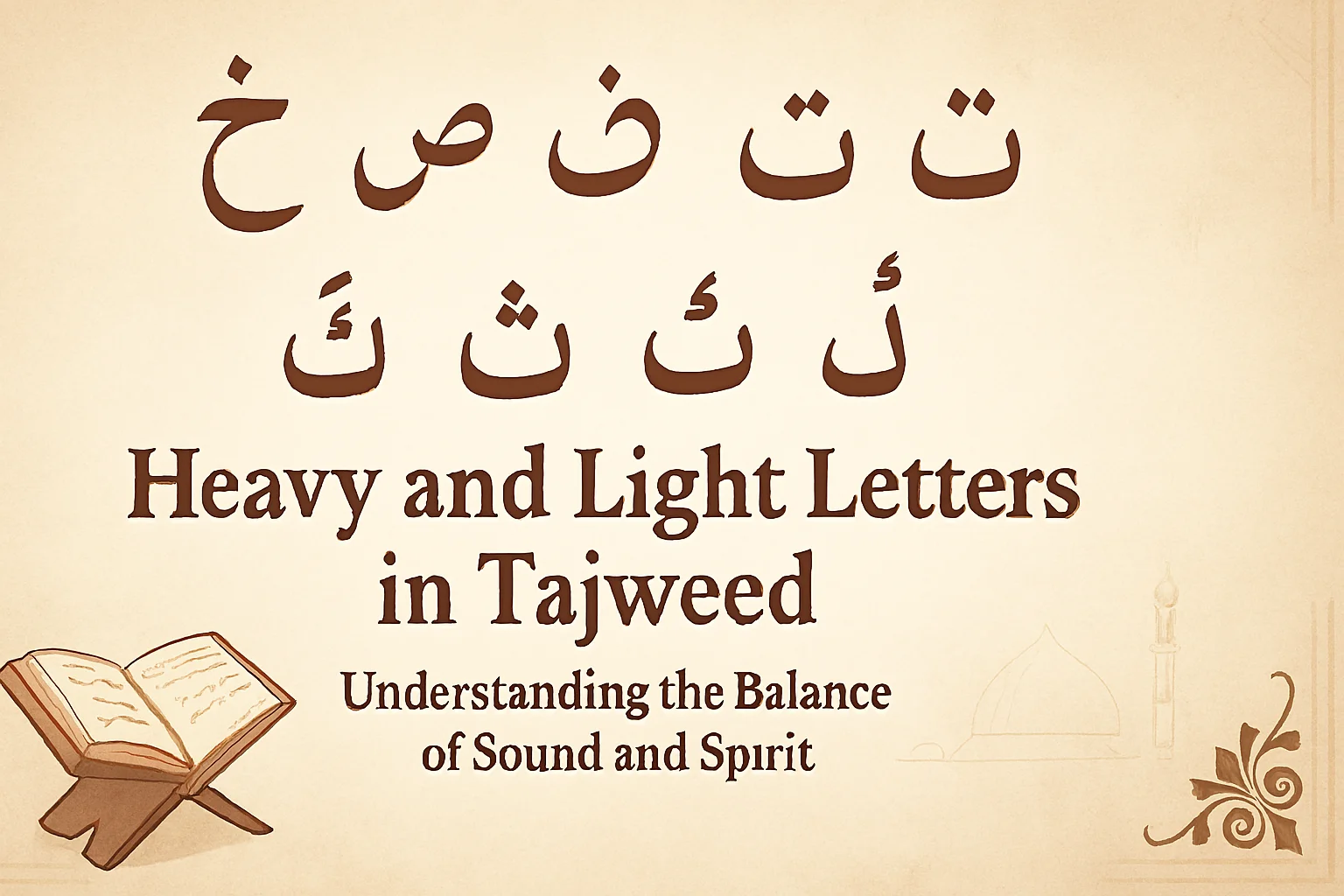
Heavy and light letters in Tajweed are crucial to mastering proper Quranic pronunciation. Known as Tafkheem (heaviness) and Tarqeeq (lightness), these rules define how each Arabic letter should sound during recitation. Seven letters are always pronounced with heaviness, while most are naturally light-and a few change depending on context. Understanding these distinctions helps prevent meaning errors and enhances the beauty and accuracy of your recitation. This guide explores how to identify and correctly pronounce heavy and light letters in Tajweed.
The Rules of Heavy and Light Letters in Tajweed
At the heart of beautiful Quranic recitation lies a wonderful balance between two qualities of sound: heaviness (Tafkheem) and lightness (Tarqeeq). These rules ensure each letter is given its proper weight and character, preserving the divine melody and meaning of the Quran.
The heavy letters, known as Huroof al-Isti’laa (خ, ص, ض, غ, ط, ق, ظ), are pronounced with a full, thick sound. This is achieved by raising the back of the tongue, creating a resonance that fills the mouth.
In contrast, the light letters are pronounced with a thin, delicate sound, which is the natural state for most of the Arabic alphabet. For these letters, the tongue remains flat and relaxed, producing a clear and crisp articulation.
Beyond these two groups, three special letters—Alif (ا), Lam (ل), and Ra (ر)—can be either heavy or light depending on specific rules. Understanding their states is key to mastering your recitation.
Learning the basics of both Tafkheem and Tarqeeq is a wonderful first step, which we cover thoroughly in Quranica’s Learn Tajweed for beginners Course.
Heavy Letters (Huroof al-Isti’laa)
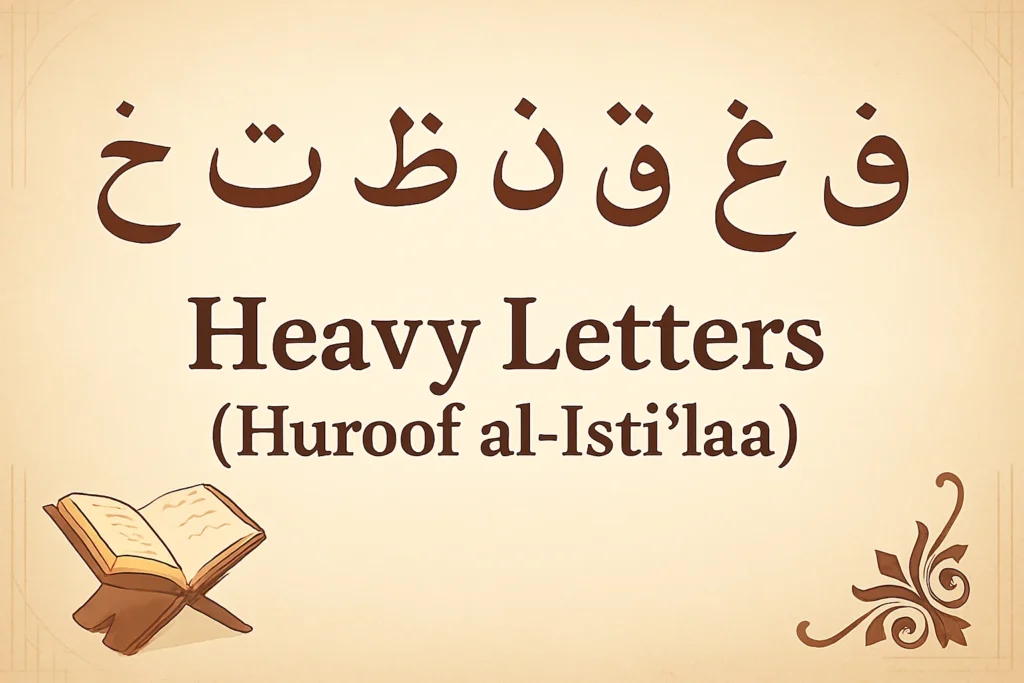
Tafkheem (التَفْخِيم) is the Tajweed rule for pronouncing certain letters with a full, thick, or heavy sound. This is achieved by raising the back of the tongue toward the soft palate, creating a resonant, “full-mouth” sound. There are seven letters that are always heavy.
1. The Letter خ (Kha)
The letter Kha (خ) is pronounced deep in the throat with a full, heavy quality, similar to a light clearing of the throat.
- Example: “خَتَمَ اللَّهُ عَلَىٰ قُلُوبِهِمْ” (khatama-llāhu ʿalā qulūbihim) – “Allah has set a seal upon their hearts…” (Al-Baqarah: 7)
2. The Letter ص (Sad)
The letter Sad (ص) combines its inherent heaviness with a whistling quality. It must never be confused with the light letter Seen (س).
- Example: “ٱهْدِنَا ٱلصِّرَٰطَ ٱلْمُسْتَقِيمَ” (ihdinaṣ-ṣiraaṭ-al-mustaqeem) – “Guide us to the straight path.” (Al-Fatiha: 6)
3. The Letter ض (Dad)
The letter Dad (ض) is unique to Arabic and is pronounced by pressing the side of the tongue against the upper molars, creating a full, compressive sound.
- Example: “وَلَا ٱلضَّآلِّينَ” (wa laḍ-ḍaalleen) – “Nor of those who are astray.” (Al-Fatiha: 7)
4. The Letter غ (Ghayn)
The letter Ghayn (غ) is articulated from the top of the throat, producing a heavy, gurgling-like sound.
- Example: “رَبَّنَا لَا تُزِغْ قُلُوبَنَا” (rabbanā lā tuzigh qulūbanā) – “‘Our Lord, let not our hearts deviate…'” (Aal-E-Imran: 8)
5. The Letter ط (Ta’)
This is considered the heaviest and strongest letter. It is the heavy counterpart to the light letter ت (Ta) and has no whisper of air.
- Example: “الشَّيْطَانُ يَعِدُكُمُ الْفَقْرَ” (ash-shayṭaanu yaidukumul-faqr) – “Satan threatens you with poverty.” (Al-Baqarah: 2:268)
6. The Letter ق (Qaf)
This letter is pronounced from the deepest part of the tongue, giving it a profound and echoing heaviness. It must not be confused with its light counterpart, ك (Kaf).
- Example: “قُلْ أَعُوذُ بِرَبِّ ٱلْفَلَقِ” (qul aoodhu birabbi-l-falaq) – “Say, ‘I seek refuge in the Lord of daybreak.'” (Al-Falaq: 1)
7. The Letter ظ (Dha’)
The letter Dha’ (ظ) is distinguished from its lighter counterparts (ذ and ث) by the elevation of the back of the tongue, which gives it its heaviness.
- Example: “ٱلَّذِينَ يَظُنُّونَ أَنَّهُم مُّلَٰقُوا۟ رَبِّهِمْ” (alladheena yaẓunnoona annahum mulaaqoo rabbihim) – “Who are certain that they will meet their Lord.” (Al-Baqarah: 2:46)
Light Letters (Huroof al-Istifal)
Tarqeeq (التَرْقِيق) is the rule for pronouncing letters with a light, thin, or flat sound. This is the natural state for most Arabic letters and is achieved by keeping the tongue flat and lowered.
1. The Letter س (Seen)
The letter Seen (س) has a light, sharp whistling sound. It is crucial not to confuse it with the heavy letter ص (Sad).
- Example: “بِسْمِ اللَّهِ الرَّحْمَٰنِ الرَّحِيمِ” (bismi-llahir-raḥmaanir-raḥeem) – “In the name of Allah, the Entirely Merciful, the Especially Merciful.” (Al-Fatiha: 1)
2. The Letter ك (Kaf)
The letter Kaf (ك) is the light counterpart to the deep and heavy ق (Qaf). It is pronounced further forward in the mouth, resulting in a light, crisp sound.
- Example: “إِنَّا أَعْطَيْنَاكَ الْكَوْثَرَ” (innaa aṭaynaak-al-kawthar) – “Indeed, We have granted you al-Kawthar.” (Al-Kawthar: 1)
3. The Letter ت (Ta)
This letter (ت) is defined by its sharpness and a distinct whisper of air (hams). It stands in direct opposition to the thick, blocking sound of the heavy letter ط (Ta’).
- Example: “تَبَّتْ يَدَا أَبِي لَهَبٍ وَتَبَّ” (tabbat yadaa abee lahabiw-watab) – “May the hands of Abu Lahab be ruined, and ruined is he.” (Al-Masad: 1)
4. The Letter ذ (Dhal)
The letter Dhal (ذ) has a soft sound, produced by placing the tip of the tongue on the edges of the top front teeth. Its lightness is the key difference between it and the heavy ظ (Dha’).
- Example: “ذَٰلِكَ الْكِتَابُ لَا رَيْبَ فِيهِ” (dhalika-l-kitaabu laa rayba feeh) – “This is the Book about which there is no doubt.” (Al-Baqarah: 2)
Read More about:
Tafkheem In Tajweed And Its Letters & Levels With Examples
Difference Between Tafkheem And Tarqeeq With Examples
Letters With Both Heavy and Light Characteristics
Three letters have special rules and can be pronounced with either Tafkheem or Tarqeeq depending on their context.
1. The Letter Ra (ر)
The state of the letter Ra changes based on its vowel:
- Heavy (Tafkheem) when it has a fatha or a damma. Example: “رَبِّ الْعَالَمِينَ” (Rabbil-‘aalameen)
- Light (Tarqeeq) when it has a kasra. Example: “فِي أَمْرٍ مَرِيجٍ” (fee amrim-mareej)
2. The Letter Alif Madd (ا)
The rule for the Alif is simple: it follows the letter before it.
- Heavy if the preceding letter is heavy. Example: “قَالَ” (qaala)
- Light if the preceding letter is light. Example: “كَانَ” (kaana)
3. The Letter Lam (ل) in the Name of Allah (الله)
The letter Lam is always light, with one major exception: the Lam in the name of Allah (الله).
- Heavy if the name of Allah is preceded by a fatha or damma. Example: “هُوَ اللَّهُ” (huwa-llahu)
- Light if the name of Allah is preceded by a kasra. Example: “بِسْمِ اللَّهِ” (bismi-llahi)
Master Tafkheem And Tarqeeq with Quranica’s Expert Guidance
Understanding these rules transforms your recitation from mere reading into a profound act of worship, connecting you more deeply to the sacred text. It is a journey of precision, beauty, and devotion. At Quranica, we believe that every student deserves to learn from the best. Our instructors are not just tutors; they are inheritors of a sacred tradition. They are:
- Native Arab tutors who are proud graduates of the prestigious Al-Azhar University.
- Ijazah-holders with certified chains of transmission (Sanad) to teach the Quran.
- Highly experienced in teaching Arabic, the Quran, and its sciences to non-native speakers with patience and clarity.
We have structured our programs to be both excellent and accessible, with competitive and affordable pricing for everyone. Whether you are a beginner or an advanced student, we have a path for you.
- Learn Quran with Tajweed (for all levels)
- Quran Memorization (Hifz) Programs
- Ijazah Course
- Islamic Studies
- Ten Qirat
- Arabic Lessons for Beginners
Explore our full range of courses. Join a Quranica course today!
Conclusion:
Mastering heavy and light letters in Tajweed is essential for anyone seeking to recite the Quran correctly and beautifully. The balance between Tafkheem and Tarqeeq gives Arabic its distinctive clarity and preserves the intended meanings of Allah’s words. Recognizing which letters are always heavy, which are always light, and which vary based on context, deepen both your understanding and your connection with the Quran. Keep practicing these rules with care, and let them guide your recitation toward excellence.



0 Comments