One of the most important rules in Tajweed is proper articulation. In Arabic, letters are pronounced from five primary articulation points or parts of the human vocal system known as “Makharij. One of them, known in Arabic as “Al-Halq” (الحلق), which means throat.
The Throat letters are very important, especially for non- Arabs since some of the throat letters provide completely new sounds, such as letters ‘ع’ (Ayn) and ‘ح’ (Ha), which don’t exist in English. This topic will clarify and explain these letters and how to pronounce them correctly, as they are essential for proper Qur’anic recitation.
Throat Letters Tajweed In Tajweed
Imam Khalil ibn Ahmad Al-Farahidi explained that the throat is one of the primary articulations, divided into three parts, each of which resembles the site of two letters based on where the sound originates within the throat.
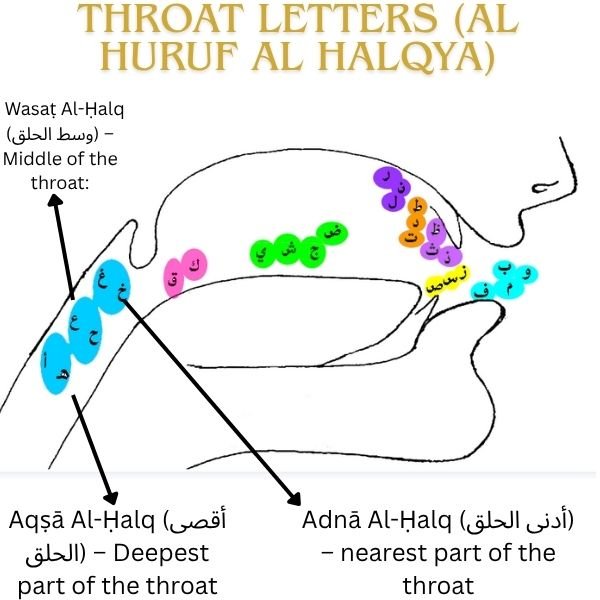
Here is a detailed outline of these three parts of the throat and the corresponding letters that originate from each, with throat letters` examples:
1. Aqṣā Al-Ḥalq (أقصى الحلق) – Deepest part of the throat:
This part of the throat is the farthest part of the throat near the vocal cords towards the chest, near the vocal cords. It is the place of articulation of 2 letters: Hamsa(ء) and Haaa (ه).
These two letters are distinguished from each other by Sifat (Attributes or articulatory characteristics), which will be explained in the following sections. See the following examples in the table:
| Quranic Word that Contains throat letter: | translation: | transliteration: |
| الله | Allah | Allah |
| رسوله | His Messenger | Rasūluhu |
| السماء | The sky/heaven | As-samā’ |
| ءامنوا | Believed | Āmanū |
2. Wasaṭ Al-Ḥalq (وسط الحلق) – Middle of the throat:
The middle part of the throat is the site of the epiglottis. From the middle part of the throat, the letters ʿAyn (ع) and Ḥāʾ (ح) are articulated. They may be strange for you at first, but with consistent practice and effort, you’ll find yourself able to pronounce them clearly and confidently. You can join Quranica Quran reading classes to practice throat letters in quran. See the examples on the table:
| Quranic Word that Contains throat letter: | translation: | transliteration: |
| عليهم | Upon them | ʿAlayhim |
| عبد | Servant | ʿAbd |
| حمد | Praise | Ḥamd |
| صلاح | Righteousness | Ṣalāḥ |
3. Adnā Al-Ḥalq (أدنى الحلق) – nearest part of the throat:
Adnā Al-Ḥalq is the closest part of the throat to the mouth and lips, located near the root of the tongue and the soft palate. Two letters are produced from this part of the throat: The first is Ghayn (غ), and the second is Khāʾ (خ). For example:
| Quranic Word that Contains throat letter: | translation: | transliteration: |
| مغفرة | Forgiveness | Maghfirah |
| تغني | Avail / Benefit | Tugh’nī |
| خاسرون | Losers | Khāsirūn |
| يخشون | They fear | Yakhshawn |
What are the 6 throat letters?
We have now learned that the six throat letters (also known as al horouf al ḥalqyīa) are: ء (hamzah), ه (hā’’), ع (‘ayn), ح (ḥā’), غ (ghayn), and خ (khā’). They all follow the Izhar rules when preceded by consonant Nun.
Although every 2 letters are pronounced from the same site of the throat, which is called secondary articulation point, every letter is pronounced by a unique group of attributes.
Throat Letters Tajweed in Arabic
To identify the precise articulation point (makhraj) of each letter, we pronounce it as a consonant immediately after a Hamzah. This technique helps us isolate and clarify its sound.
Here is a detailed overview of how to pronounce each letter from its right articulation and attributes.
1. Hamza ء) – الهمزة)
The letter Hamza (ء) is articulated from Aqṣā Al-Ḥalq. The tongue contributes to sound production only by lowering itself to the bottom of the mouth without touching the upper palate. This creates a gap that narrows the oral cavity.
The actual sound is produced at the very back of the throat, where pressure is felt due to the strong reliance on the articulation point. The sides of the throat come close together, trapping the sound. During this, the vocal cords are tightly closed, preventing air from passing. Then, they suddenly open, releasing the trapped air and creating the Hamza sound.
Hamza characteristics include being: voiced (majhoor), plosive (shadeed), thin (muraqqaq), sharp in tone, and strong in impact. We explain more about letters in our Basic Tajweed course.
2. Haa ه) – الهاء )
The Arabic letter Haa’ (هـ) is one of the softest and lightest letters in the Arabic language because of its weak and breathy nature. Like Hamza, it originates from Aqṣā Al-Ḥalq.
The fundamental difference between Haa (هـ) and Hamza (ء) is the vibration of the vocal cords. The important characteristics of Haa’ are:
1. Softness (rakhawa): This means that sound is not fully stopped.
2. Whisperedness (hams): It’s pronounced with a lot of breath and without strong vibration of the vocal cords.
3. Lightness (muraqqaq): It is always pronounced lightly and never heavy.
4. Open (munfatiḥ): Its sound does not press against the roof of the mouth.
3. Haa ح) – الحاء):
The letter Ḥāʼ is pronounced from the middle part of the throat. During its articulation, the tongue drops to the floor of the mouth and does not touch the roof (palate). This causes the oral cavity to narrow, and the sound flows downward into the dome of the mouth.
The characteristics (Sifaat) of Haa (ح) are the same as Letter Haa(ه), but they differ in the place of articulation.
3. Aynع) – العين )
The letter ‘Ayn (ع) is articulated from the middle of the throat, just like the letter Ḥā’ (ح). However, it differs from Ḥā’ in two key characteristics: jahr (being voiced) and Tawassut.
The letter ʿAyn requires careful attention when pronounced. Since it is characterized by the attribute of “Tawassut” (moderation), which means the sound of ʿAyn is neither completely cut off like strong sounds (shadeed) nor flowing like soft sounds (rakheeh). Instead, it’s in between.
Therefore, when pronouncing ʿAyn, the sound starts with a small stoppage and then flows gently, fading out just before reaching the upper throat.
Without these two features — voicing and partial obstruction — the ‘Ayn would have been identical to Ḥā (ح).
5. Khaa خ) – الخاء):
The particular articulation of the letter Khā’ (خ) is slightly above the articulation point of the letter Ghayn (غ), closer to the mouth. It involves the upper part of the back wall of the throat.
The contact at the articulation point is weak, occurring when the back of the tongue rises and approaches the uvula (the fleshy hanging part at the back of the throat) without completely closing the passage.
At the same time, the tip of the tongue lowers toward the bottom of the mouth, due to the action of the muscles attached underneath the tongue. This is a natural mechanical process: when the back of the tongue rises, its tip lowers except in the case of emphatic letters (Itbāq letters), where the mechanism differs.
As the sound emerges from its source, it hits the tongue and finds no clear path to exit. So, it rises upward toward the roof of the mouth (palate), and the mouth fills with its echo due to its reverberation inside the oral cavity.
The vocal cords remain apart, so the air passes without any blockage. The sound requires effort and breath support to be pronounced properly. The speaker must force air through the space between the vocal cords until a gentle rasping sound (kharkharah) is produced, without overdoing it.
6. Ghayn غ) – الغين):
The letters “غ” (Ghayn), like “خ” (Khaa), are articulated from the lowest part of the throat, closest to the mouth. The letter (Ghayn) comes from a slightly lower position in the throat than “خ” (Khaa).
They both have similar characteristics, except that “غ” is voiced (majhour), meaning the vocal cords vibrate during its pronunciation, while “خ” is unvoiced.
Common Mistakes in Throat Letter (Huruf Halqiyyah) Tajweed:
Common mistakes in pronouncing Huruf Halqiyyah include confusing similar throat letters like خ and غ, misarticulating ح and هـ, softening the glottal Hamzah, and improperly pronouncing خ when it carries sukoon. Accurate articulation and understanding of each letter’s origin are essential to avoid altering meanings.
1. Confusing “Kh” (خ) with “Ghayn” (غ)
While reading, you may be unable to distinguish between these two sounds, especially if they don’t exist in your native languages. As a result, you may pronounce ghayn (غ) like khaa’ (خ) or vice versa, especially when the letter is silent (sukoon).
Saying (المغضوب “Al-Maghdoob) With a Khaa instead of Ghayn changes the meaning, so you must differentiate between their points of articulation: Khaa is whispered (Hams), Ghayn is voiced (Jahr).
2. Pronouncing “Haa” (ح) as “Kh” (خ) or “Haa” (ه)
For example, saying “الحمد لله” as “Hamdu Lillah” with هـ, or even “Khamdu Lillah”.
You can avoid this by understanding that Haa (ح) must come from the middle of the throat and sound pure and soft.
3. Softening or Replacing the Glottal Stop (Hamzah – ء)
Some readers avoid struggling with the glottal sound of Hamza by softening it or replacing it with a vowel like alif or waw, which leads to unclear or incorrect pronunciation.
For example, when pronouncing the word (السماء), Hamza must be pronounced clearly and sharply.
4. Not Articulating “Kh” (خ) Properly When Sukooned
The khaa’ (خ) sound requires continuous airflow. Non-native speakers either over-emphasize it—making it sound like a qaaf (ق) or drop it entirely when it is consonant (sakiina).
For example, while saying يغفر“Yaghfir”, it is converted into “Yaqfir”. You should be careful to pronounce each letter from its correct place and read more about sukoon rules
Improve your pronunciation of throat letters With Quranica:
Join Quranica Advanced Tajweed Course to master throat letters and all tajweed rules. We help you through regular practice with qualified Arabic Quranic recitation instructors who can provide convenient feedback and corrections.
Our course follows gradual learning methods, ensuring that you master the tajweed rule before moving to the next. We also focus with you on the practical part of the tajweed rules, so that you can read the Quran confidently and smoothly.
We invite you to explore our specialized online courses:
- Online Quran Classes for Beginners: Take your first confident step into the world of the Quran.
- Learn Quran with Tajweed: Perfect your recitation and beautify your connection with the divine word.
- Hifz Classes for Ladies and Sisters: Join a comfortable and supportive environment designed for sisters to memorize the Book of Allah.
Explore our full range of courses.
Conclusion:
The throat (al-ḥalq) is one of the five general articulation areas. It contains three specific (secondary) articulation points which are distinct locations within the throat from front to back.
Each of these three points is responsible for two distinct letters.
In total, throat letters are six and each letter has a precise articulation point and specific characteristics (ṣifāt) that ensure its correct pronunciation according to the rules of Tajweed.
What are the letters of the throat tajweed?
There are six letters of the throat. These six letters are grouped in the well-known Arabic mnemonic line:
همزٌ فهاءٌ ثم عينٌ حاءُ
مهملتـان ثم غيـنٌ خـاءُ
Transliteration:
Hamzah and Haa’, then ‘Ayn and Haa’ (both soft), then Ghayn and Khaa.
To master the letters of the throat tajweed, you should practice reading and applying its characteristics.
Is Hamza a throat letter?
Yes, Hamza is a throat letter that emerged from Aqsah Al Half (the deepest part of Al Half near the chest.

0 Comments