Surah Al-Fatiha is the first surah in the Quran and one of its most significant ones. It contains only seven verses, yet is perhaps the most important surah in the Quran because it combines the most significant concepts of Islam, which are: glorifying Allah, understanding His mercy, and power, worshipping Him only, and asking Him for help as well as direction.
It is important to note that Al-Fatiha is recited in each prayer, and Muslims repeat the same words over and over again. However, understanding the meaning of the surah will made it possible to turn the same words into communication with Allah.
In this article, we will analyze the meaning of the surah, its verses, we will provide ayah by ayah tafsir, we will explain why Al-Fatiha is so important during Salah, and we will also mention its main virtues and what it can teach us about faith and life.
Surah Al-Fatiha at a Glance
| Detail | Information |
|---|---|
| Surah | Al-Fatiha |
| Surah number | 1 |
| Meaning | The Opening |
| Number of verses | 7 |
| Juz | 1 |
| Main themes | Praise, mercy, worship, reliance, judgment, and guidance |
| Also known as | Al-Fatihah, Umm Al-Kitab, Umm Al-Quran, As-Sab‘ Al-Mathani |
Quranic verses about Surah Al-Fatiha
وَلَقَدْ ءَاتَيْنَـٰكَ سَبْعًۭا مِّنَ ٱلْمَثَانِى وَٱلْقُرْءَانَ ٱلْعَظِيمَ
(Umm Al-Qur’an (the Mother or the Essence of the Qur’an,) is the seven Mathani, and the Grand Qur’an.) This means that Surah Al-Fatihah is the seven Mathani and the Grand Qur’an, but this does not contradict the statement that the seven Mathani are the seven long Surahs. (Al-Hijr15:87)
Read more : Quranic Verses
Surah Al-Fatiha in Arabic & English translation
بِسْمِ اللّٰهِ الرَّحْمٰنِ الرَّحِیْمِ
اَلْحَمْدُ لِلّٰهِ رَبِّ الْعٰلَمِیْنَۙ (1) الرَّحْمٰنِ الرَّحِیْمِۙ (2) مٰلِكِ یَوْمِ الدِّیْنِﭤ(3) اِیَّاكَ نَعْبُدُ وَ اِیَّاكَ نَسْتَعِیْنُﭤ(4) اِهْدِنَا الصِّرَاطَ الْمُسْتَقِیْمَۙ (5) صِرَاطَ الَّذِیْنَ اَنْعَمْتَ عَلَیْهِمْ (6)غَیْرِ الْمَغْضُوْبِ عَلَیْهِمْ وَ لَا الضَّآلِّیْنَ۠ (7)
English translation:
1.In the Name of Allah—the Most Compassionate, Most Merciful. 2.All praise is for Allah—Lord of all worlds,1 3.the Most Compassionate, Most Merciful, 4.Master of the Day of Judgment. 5.You ˹alone˺ we worship and You ˹alone˺ we ask for help. 6.Guide us along the Straight Path, 7.the Path of those You have blessed—not those You are displeased with, or those who are astray. Quran.com
Meaning of Surah Al-Fatiha
The term Al-Fatiha in Arabic refers to “The Opening.” the name Al-Fatiha indicates that it opens the Quran.
However, its significance is not only linked to its location at the very beginning of the Mushaf. In actuality, the surah is an introduction of the relationship between Allah and the believer.
The surah starts with praising, Then it emphasizes Allah’s compassion, It mentions the Day of Judgments.
Then the believer voices out the following words:
“It is You we worship and You we seek help from.”
Consequently, the believer requests the most precious thing possible, namely, the guidance towards the Straight Path.
In this regard, Surah Al-Fatiha proceeds from knowledge of Allah to worshiping Allah and asking Him for guidance.
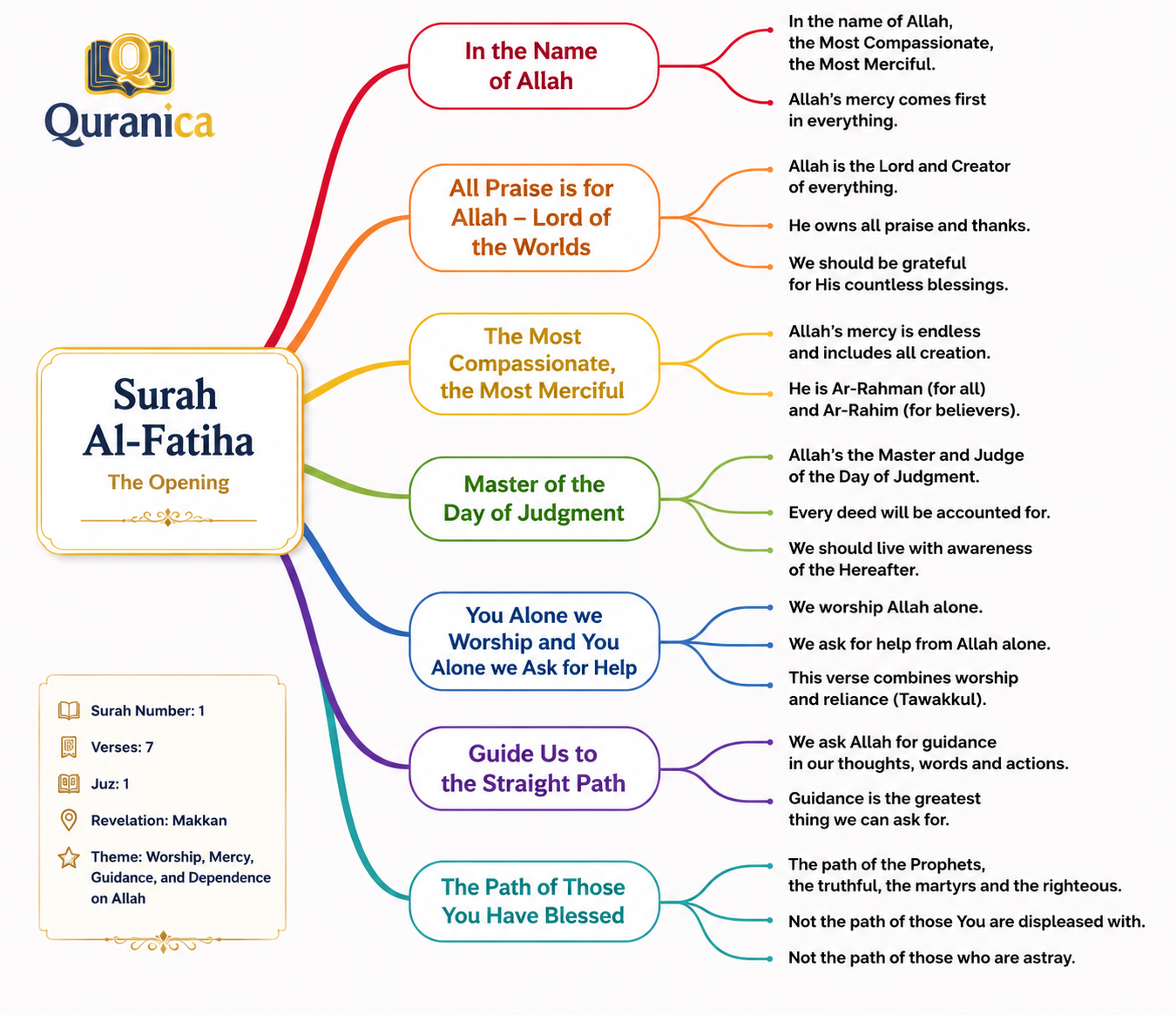
Surah Al-Fatiha Mind Map
The seven verses can be understood as one connected message:
Praise → Mercy → Judgment → Worship → Reliance → Guidance → The Straight Path
Surah Al-Fatiha Tafsir: Verse-by-Verse Meaning
1. “In the Name of Allah, the Entirely Merciful, the Especially Merciful”
بِسْمِ اللَّهِ الرَّحْمَٰنِ الرَّحِيمِ
The surah begins with a mention of Allah along with His two beautiful names, namely, Ar-Rahman and Ar-Rahim.
These names are associated with the mercy of Allah.
It is an effective opener because before mentioning worship, judgment and our need for guidance, the surah explains to us about the mercy of Allah.
It tells the believer that Allah is not distant from His creation. Instead, His mercy envelops the world around us and makes believers hopeful of approaching Him.
2. “All Praise Is for Allah—Lord of the Worlds”
الْحَمْدُ لِلَّهِ رَبِّ الْعَالَمِينَ
The term Al-Hamd implies repentance and appreciation.
Allah is called Rabb al-‘Alamin — Owner of the Universe.
He is the Creator, Maintainer, and Owner of each and everything.
This verse illustrates that our gratitude should commence from Allah.
Before one asks Allah for something, Surah Al-Fatiha tells one to acknowledge Him and respect Him.
A lesson to learn every day:
It’s easy to concentrate on things we do not possess.
Surah Al-Fatiha demands from us to pause and realize what Allah has given us at this point in life.
Gratitude is the beginning of the dialogue.
3. “The Entirely Merciful, the Especially Merciful”
الرَّحْمَٰنِ الرَّحِيمِ
The mercy of Allah is brought up yet again. This shows an important part of our understanding about Allah. A believer must remain hopeful about the mercy of Allah and obey Him.
Surah Al-Fatiha therefore balances our relationship with Allah: we recognize His greatness and authority, but we also know Him as the Most Merciful.
4. “Sovereign of the Day of Recompense”
مَالِكِ يَوْمِ الدِّينِ
The Surah proceeds from the mercy of Allah onto the Day of Reward.
This is the Day when a person will be judged based on his deeds.
The remembrance of the Hereafter makes a believer rethink his life.
It is important what the individual does.
It is important how the person worships God.
It is important how the person acts toward others.
In this life, we need to remember that everything matters.
5. “It Is You We Worship and You We Ask for Help”
إِيَّاكَ نَعْبُدُ وَإِيَّاكَ نَسْتَعِينُ
This is what we can call one of the key messages of Surah Al-Fatiha.
The believer is saying the following:
“It is You we worship.”
Worship is meant only for Allah.
After that comes:
“And You we ask for help.”
The believer admits that he is subject to Allah’s might.
This verse introduces two concepts thus:
Worship is devoted to Allah.
Reliance is to seek Allah’s help.
This transition is very strong. In the first part of Surah we learn about Allah, then the believer gives his answer to Allah.
6. “Guide Us to the Straight Path”
اهْدِنَا الصِّرَاطَ الْمُسْتَقِيمَ
After giving praise to Allah and professing our worship, we ask Allah to guide us.
“Guide us,” we say.
But what is the reason behind this request? Why do we ask Allah for guidance when we already believe in Allah?s guidance?
This is because guidance is not needed only once.
In order to receive Allah’s guidance in our lives.
We need guidance to:
- To know what is right.
- To avoid what is bad.
- To make the right decisions.
- To stay strong in faith.
- To worship Allah perfectly.
- To deal with hardships.
- To avoid paths that take us away from Him.
7. “The Path of Those You Have Blessed”
صِرَاطَ الَّذِينَ أَنْعَمْتَ عَلَيْهِمْ
The last verse starts to discuss what is meant by the Straight Path.
We are praying to God to put us amongst the people God bestowed favor upon.
In this way, we learn from the holy book who are the chosen ones of God.
Allah calls people like prophets, truthful individuals, martyrs, and righteous ones the believers in Surah An-Nisa 4:69.
It means that a believer is striving to follow the path of those who live according to God’s orders.
“Not of Those Who Have Earned Your Anger or Those Who Are Astray”
غَيْرِ الْمَغْضُوبِ عَلَيْهِمْ وَلَا الضَّالِّينَ
The last part requests Allah to protect us from those roads which divert us from guidance.
Classically, tafsir interprets these characteristics as individuals who understand the truth but refuse to act accordingly and people who are simply misled away from the truth.
There is a valuable lesson in this for each individual.
It is insufficient to know something.
A true believer comprises both:
having knowledge about the truth + doing something to follow it.
🚀 Start My FREE Quranica Trial →
Why Is Surah Al-Fatiha Important in Salah?
One of the most important things to understand about Al-Fatiha is its connection to Salah.
The Prophet ﷺ said :
” لاَ صَلاَةَ لِمَنْ لَمْ يَقْرَأْ بِفَاتِحَةِ الْكِتَابِ”
that the prayer is not complete without reciting the opening chapter of the Book. This is reported in both Sahih al-Bukhari and Sahih Muslim.
That means Al-Fatiha is not simply a surah that Muslims happen to memorize.
It is an essential part of the prayer according to the well-known hadith evidence.
And there is something even more profound about this.
In Sahih Muslim, the Prophet ﷺ narrated that Allah said He had divided the prayer between Himself and His servant, and the hadith then explains the response associated with each part of Al-Fatiha.
For example, when the worshipper says:
“All praise is for Allah, Lord of the worlds,”
Allah responds that His servant has praised Him.
When the worshipper says:
“It is You we worship and You we ask for help,”
Allah says that this is between Him and His servant, and that the servant will receive what he asks.
And when the worshipper asks:
“Guide us to the Straight Path,”
Allah responds that this is for His servant and that His servant will receive what he asks.
This gives Al-Fatiha a remarkable meaning during Salah.
You are not simply repeating words you memorized as a child. You are making a declaration and a supplication before Allah. sunnah.com
What Are the Virtues of Surah Al-Fatiha?
The merits of Al-Fatiha are verified through credible hadith.
- It Is the Seven Oft-Repeated Verses
The Prophet ﷺ stated that Al-Fatiha is seven ongoing verses, at the same time he called it a wonderful surah of the Quran.
Every Muslim is obliged to recite it frequently in Salah, which is one of the main reasons for its importance in a Muslim’s life. - Mandatory in the Prayer
There are evident hadith which stress that the prayer without the recitation of the first chapter of the Quran is invalid.
Even though the scholars may disagree on certain issues concerning the recitation behind the imam, it is wise to leave those matters aside. - It Was Used as Ruqyah
There is a well-known narration in Sahih al-Bukhari in which there is a case of a companion who used Al-Fatiha as a cure for another man, who was bitten. Once this fact was brought to the Prophet ﷺ, He approved this action and wanted to know how the companion had come to know about the existence of Al-Fatiha as a cure.
This establishes a specific virtue of Al-Fatiha without requiring us to make unsupported claims about every possible benefit.
Frequently Asked Questions About Surah Al-Fatiha
How many verses are in Surah Al-Fatiha?
Surah Al-Fatiha contains seven verses. The Prophet ﷺ referred to it as the seven oft-repeated verses.
What does Surah Al-Fatiha mean?
Al-Fatiha means “The Opening.” It is the first chapter of the Quran and focuses on praising Allah, His mercy and authority, sincere worship, seeking His help, and asking for guidance.
Why is Surah Al-Fatiha called “The Opening”?
It is called Al-Fatiha because it is the opening surah of the Quran.
What is the main message of Surah Al-Fatiha?
Its central message is to recognize Allah, praise Him, worship Him alone, rely upon Him, and ask Him to guide us to the Straight Path.
Why do Muslims recite Surah Al-Fatiha in Salah?
Authentic hadith establish the central importance of reciting Al-Fatiha in prayer. The Prophet ﷺ said that the prayer is incomplete without the opening chapter of the Quran.
What are the virtues of Surah Al-Fatiha?
Among its established virtues are that it is the seven oft-repeated verses, that it has a central role in Salah, and that it was approved by the Prophet ﷺ as ruqyah in an authentic incident.
Is Surah Al-Fatiha a dua?
Yes. The final verses contain a direct supplication to Allah, especially the request:
“Guide us to the Straight Path.”
The hadith in Sahih Muslim specifically describes Allah’s response to the servant’s request for guidance in Al-Fatiha.
What does “Guide us to the Straight Path” mean?
It is a request for Allah to guide us to the path of truth and righteousness and keep us firm upon it. Classical tafsir explains the Straight Path as the true religion and the path of those whom Allah has favored.
Begin Your Journey With the Quran
Learning Surah Al-Fatiha is a beautiful place to begin understanding the Quran. But its message is just the beginning of a much greater journey through the words, meanings, and guidance of Allah.
If you want to continue learning, explore our Online Quran Course and Online Tafseer Course to study the Quran more deeply with a teacher.
You can also continue exploring the Quran one chapter at a time through our complete guide to the 114 Surahs of the Quran, where you can learn about each surah and its main themes.
0 Comments